
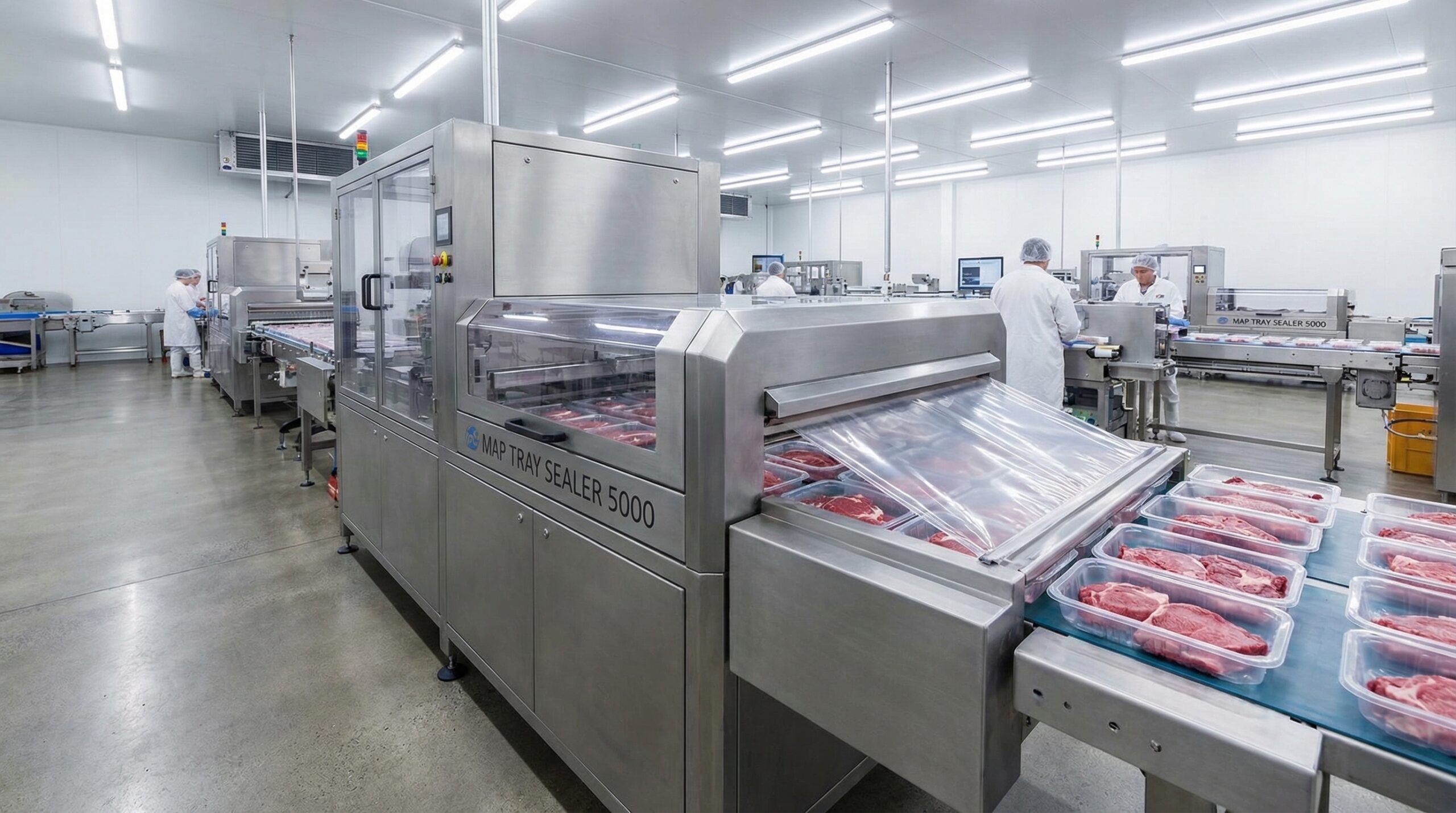
MAP Tray Sealing Machine Market Hits $165M in 2025 — What Food Manufacturers Must Know for 2026
MAP Tray Sealing Machine Market in 2026: A $165M Opportunity — And Why It’s Still Growing
If you manufacture, process, or package fresh food — and you’re not paying close attention to Modified Atmosphere Packaging (MAP) tray sealing technology — you’re leaving shelf life, margin, and market share on the table.
The numbers are clear. The global automatic MAP tray sealing machine market was valued at approximately $165 million in 2025, and is projected to reach $228 million by 2032, growing at a compound annual growth rate (CAGR) of 4.8% through 2032 (QY Research, 2026). That’s not a niche trend — it’s a structural shift in how fresh food moves from processing facility to retail shelf.
In the United States alone, over 69% of packaged protein products are now sealed using tray sealing packaging machine systems, and 63% of supermarkets stock MAP-based sealed trays as a standard category (360 Research Reports, 2026).
Whether you’re running a meat processing plant in North America, a seafood export operation in Southeast Asia, or a ready-meal production line in Europe, MAP tray sealing technology deserves a strategic review.
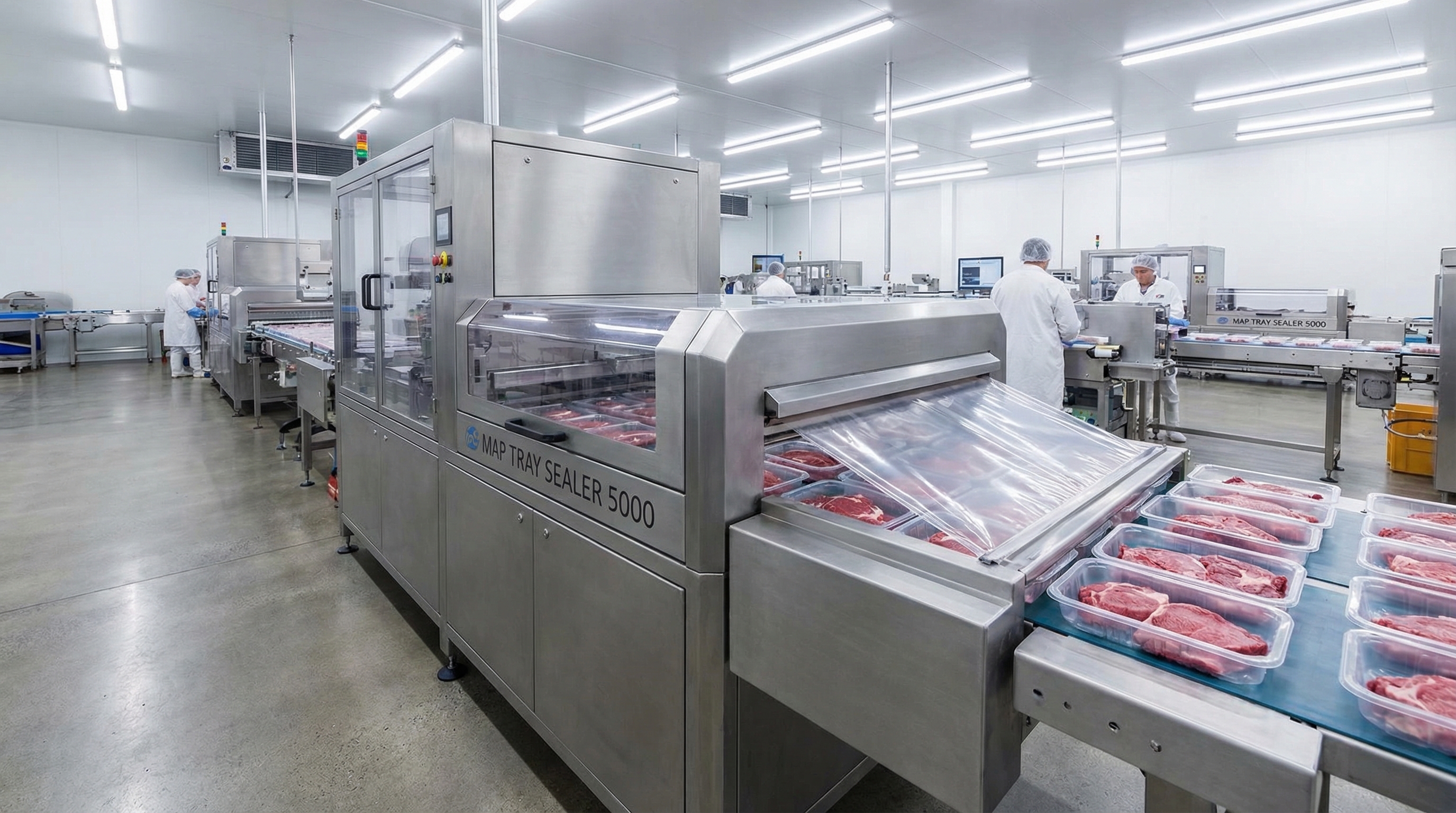
What Is MAP Tray Sealing — And Why Does It Work So Well?
Modified Atmosphere Packaging (MAP) is a preservation technique that replaces the air inside a food package with a precisely mixed protective gas atmosphere — before the package is hermetically sealed.
Unlike vacuum packaging (which removes most atmospheric gas), MAP replaces it with a tailored blend. The three gases most commonly used are:
| Gas | Role in MAP | Typical Use |
|---|---|---|
| CO₂ (Carbon Dioxide) | Antibacterial, inhibits microbial growth | All fresh meat, poultry, fish |
| N₂ (Nitrogen) | Inert filler, prevents package collapse from CO₂ absorption | Padding gas, dry products |
| O₂ (Oxygen) | Maintains red meat colour (oxymyoglobin), supports respiration for fresh produce | Red meat, fresh vegetables |
The science works because most spoilage microorganisms — aerobic bacteria, molds, and yeasts — require oxygen to grow. By displacing O₂ with CO₂-heavy or N₂-heavy atmospheres, you dramatically slow spoilage without the compression and liquid loss associated with aggressive vacuum抽空.
MAP Tray Sealing vs Vacuum Packaging — When to Choose Which
Both technologies extend shelf life. But they serve different product profiles and retail contexts:
| Factor | MAP Tray Sealing | Vacuum Packaging |
| Ideal products | Fresh meat, poultry, fish, cheese, ready meals | Raw ingredients, bulk storage, dry goods |
| Visual presentation | Excellent — product is visible, not compressed | Compressed, less retail-friendly for fresh cuts |
| Shelf life extension | 2–5× vs. aerobically packaged | 3–7× vs. aerobically packaged |
| Equipment cost | Mid-to-high ($20,000–$200,000+) | Variable ($5,000–$150,000) |
| Film/seal complexity | Higher (lidding film + gas flush) | Lower (single film) |
| Gas consumption | Yes — requires gas supply | No |
| Best retail channel | Supermarkets, hypermarkets | Food service, industrial, bulk |
Bottom line: MAP tray sealing is the preferred choice for retail-ready fresh protein packaging — the segment with the highest margin and the most demanding consumer presentation standards.
Global MAP Tray Sealing Machine Market — Key Data Points for 2026
### Market Size & Growth – 2025 market value: ~$165 million (QY Research) – 2032 projected value: ~$228 million – CAGR 2025–2032: 4.8% – Automatic tray sealing machines market 2025: $5.83 billion — growing strongly (The Business Research Company, 2026)
### Regional Adoption – USA: 69%+ of packaged protein uses tray sealing systems; 63%+ supermarket coverage – Europe: Strong adoption in Germany, UK, France for retail fresh meat and cheese segments – Asia-Pacific: Fastest-growing region — driven by rising middle-class demand for fresh convenience foods in China, India, and Southeast Asia – China: Domestic MAP adoption accelerating; KBT Packaging and other domestic manufacturers now producing rotary MAP tray sealers at globally competitive price points
### Technology Trends Driving 2026 Growth 1. Intelligent gas mixing systems — Proportional gas blend control based on product weight and type, reducing gas waste by up to 15% 2. Inline freshness sensors — Early-adoption MAP systems now testing O₂/CO₂ sensors that adjust gas composition in real time 3. High-speed rotary tray sealers — Up to 20–60 cycles/minute on premium equipment, enabling high-throughput retail packaging lines 4. Sustainability push — Recyclable mono-material lidding films and reduced gas fill volumes are emerging as competitive differentiators 5. IoT and remote monitoring — Connected tray sealers with real-time cycle data, predictive maintenance alerts, and OEE dashboards
The Science of MAP Gas Mixtures for Fresh Meat — A Practical Guide
Getting MAP right is a science. The wrong gas blend can accelerate discoloration, off-odour development, or drip loss — all of which destroy consumer confidence.
### Recommended MAP Gas Blends by Product
| Product | Typical Gas Mix | Shelf Life Extension |
|---|---|---|
| Beef (fresh red meat) | 70–80% CO₂ / 20–30% N₂ | 5–7 days → 8–12 days |
| Pork | 60–70% CO₂ / 30–40% N₂ | 4–6 days → 7–10 days |
| Poultry | 50–70% CO₂ / 30–50% N₂ | 6–9 days → 10–14 days |
| Fish & Seafood | 30–40% CO₂ / 60–70% N₂ (low O₂) | 3–5 days → 6–9 days |
| Cooked/Cured Meats | 20–30% CO₂ / 70–80% N₂ | 14–21 days → 21–35 days |
| Hard Cheese | 100% CO₂ or 80% N₂ / 20% CO₂ | 30 days → 60–75 days |
### Common MAP Mistakes to Avoid – Too much O₂ in red meat packages — Leads to lipid oxidation and rancidity, not colour improvement – CO₂ absorption causing package collapse — Offset with N₂ filler; monitor at high altitude where differential pressure increases – Film oxygen transmission rate (OTR) mismatch — High-barrier films are essential for low-O₂ MAP blends – Inconsistent gas flushing — Uneven gas distribution causes “hot spots” of accelerated microbial growth
How to Choose the Right MAP Tray Sealing Machine for Your Production Line
With the market expanding, equipment options are proliferating. Here’s how to evaluate machines systematically:
### Key Evaluation Criteria
1. Cycle Speed vs. Throughput Requirements – Manual/semi-automatic tray sealers: 3–8 cycles/min — suitable for small operations – Automatic rotary tray sealers: 12–30 cycles/min — standard for medium-scale production – High-speed rotary systems: 40–80 cycles/min — for large retail packaging operations
2. Tray Size and Format Flexibility – Single-format machines are cheaper but less future-proof – Look for quick-change tooling systems that accept multiple tray dimensions without full retooling
3. Vacuum Pump Brand — It Matters More Than You Think The vacuum pump is the heart of the MAP tray sealer. Three brands dominate the food packaging sector: – Busch (Germany): Industry benchmark. Exceptional speed, low oil consumption, widely available globally. Preferred by premium European manufacturers. – Leybold (Germany): High performance, advanced control systems, strong in automated lines. – Becker (Germany): Proven reliability, competitive price point, widely used in mid-range Chinese and European equipment.
4. Gas Flushing System – Single-stage flush (faster, lower gas consumption) vs. double-stage flush (more complete O₂ displacement — essential for low-O₂ MAP blends) – Digital gas mixer with individual flow meters vs. fixed-ratio mixing valve
5. Control System – PLC-based systems (Mitsubishi, Siemens) offer reliability and global spare parts availability – Touchscreen HMI with recipe storage is essential for multi-product facilities
6. After-Sales Support and Spare Parts – Evaluate whether the manufacturer maintains spare parts inventory for your region – Confirm remote diagnostic capability (increasingly standard on mid-to-premium equipment) – Ask about on-site installation and operator training included in the purchase price
MAP Tray Sealing for Specific Food Categories — Industry Breakdown
### Fresh Red Meat The largest MAP application globally. Key driver: retail demand for case-ready meat with extended shelf life and premium presentation. Leading packers use high-O₂ blends (70% CO₂ / 30% N₂) to maintain the bright red oxymyoglobin colour consumers associate with freshness.
### Poultry Second-largest segment. Lower fat oxidation risk than red meat — CO₂-dominant blends are highly effective. MAP-packaged poultry typically commands a 10–15% retail price premium over conventional overwrapped trays.
### Seafood The most technically demanding MAP application. Fish and shellfish are highly perishable and sensitive to temperature abuse. Low-O₂ MAP blends (high N₂, reduced CO₂) reduce drip loss and texture degradation. Some operators combine MAP with slurry ice for maximum shelf life extension.
### Cheese MAP extends the shelf life of hard and semi-hard cheeses by 2–3× without affecting flavour or texture. 100% CO₂ or CO₂/N₂ blends work well; the CO₂ inhibits mould growth.
### Ready-to-Eat (RTE) Meals High-growth segment driven by consumer demand for convenient meal solutions. MAP tray sealing preserves visual quality and extends refrigerated shelf life from 3–5 days to 7–12 days — critical for meal kit delivery and retail deli operations.
FAQ — MAP Tray Sealing Machine Market & Technology
Q: What is the difference between a tray sealer and a MAP tray sealer? A: A standard tray sealer hermetically seals a lidding film onto a pre-formed tray — but it does not introduce protective gas. A MAP tray sealer performs gas flushing (replacing air with a tailored gas blend) before sealing. The result is significantly extended shelf life compared to standard sealed trays.
Q: How much does a MAP tray sealing machine cost? A: Entry-level semi-automatic MAP tray sealers start around $8,000–$20,000. Automatic rotary MAP tray sealers with gas flushing range from $30,000–$150,000 depending on speed, tray size, and pump brand. High-speed industrial systems can exceed $200,000.
Q: What is the ROI of investing in MAP tray sealing equipment? A: For a typical medium-scale fresh meat processor running 2,000+ trays/day, MAP packaging can justify investment through reduced product waste (from 8–12% under conventional packaging to 2–3%), increased retail shelf life enabling wider distribution reach, and premium pricing for retail-ready packaging. Payback periods of 18–36 months are common in well-matched applications.
Q: Can MAP tray sealing be used with biodegradable or compostable packaging materials? A: Yes, but with constraints. Standard EVOH high-barrier films are not compostable. Emerging mono-material PE or PP recyclable films are compatible with some MAP tray sealers — but OTR (oxygen transmission rate) must be carefully validated. Fully compostable MAP remains a developing technology in 2026.
Q: Is MAP packaging safe from a food safety perspective? A: Yes, when properly implemented. MAP is approved by the FDA, EFSA (Europe), and CFIA (Canada) for fresh food applications. The key is maintaining cold chain integrity — MAP does not kill microorganisms, it inhibits their growth. Any temperature abuse dramatically reduces shelf life benefit.
Q: Which vacuum pump brand is best for MAP tray sealing machines? A: Busch is the gold standard for premium applications, offering the fastest evacuation抽空抽空抽空抽空抽空抽空抽空抽空抽空抽空抽空抽空抽空 speeds and lowest maintenance requirements. Leybold is equally capable technically, often at a slight price premium. Becker offers excellent value for mid-range applications. All three are preferable to generic pump brands for food processing reliability.
The 2026 MAP Tray Sealing Outlook — What Food Manufacturers Should Do Now
The MAP tray sealing machine market is not a future bet — it’s a present opportunity. With market value already at $165M and growth trajectories pointing to $228M by 2032, the question is no longer whether MAP will be relevant — it’s how fast your operation needs to adopt or upgrade.
For food manufacturers evaluating MAP technology in 2026:
1. Audit your current shelf life performance — If you’re losing more than 5% of output to spoilage or nearing sell-by dates, MAP can directly reduce this waste. 2. Evaluate your retail channel requirements — Major supermarket chains increasingly mandate MAP or vacuum skin packaging for case-ready fresh protein. This is a channel access requirement, not just an efficiency choice. 3. Start with a pilot — Most reputable MAP equipment suppliers will run sample sealing tests with your actual product. This gives you real shelf-life data before capital commitment. 4. Invest in the gas supply infrastructure — MAP requires bulk liquid CO₂ and N₂ supply. Factor gas tank rental, delivery contracts, and gas monitoring into your operational cost model. 5. Train your operators — MAP shelf life is sensitive to sealing quality, gas mix accuracy, and cold chain management. Operator error can negate the technology’s benefits.
Looking to explore MAP tray sealing solutions for your production line? [Contact KBT Packaging](/contact/) for a technical consultation — or browse our range of [automatic MAP tray sealing machines](/modified-atmosphere-packaging-machine/) designed for food manufacturers exporting to global markets.
Market data sources: QY Research (Automatic MAP Tray Sealing Machine Market 2026); 360 Research Reports (Tray Sealing Packaging Machine Market Trends 2026); The Business Research Company (Automatic Tray Sealing Machines Market Report 2026). All machinery brands referenced are for informational purposes only.