
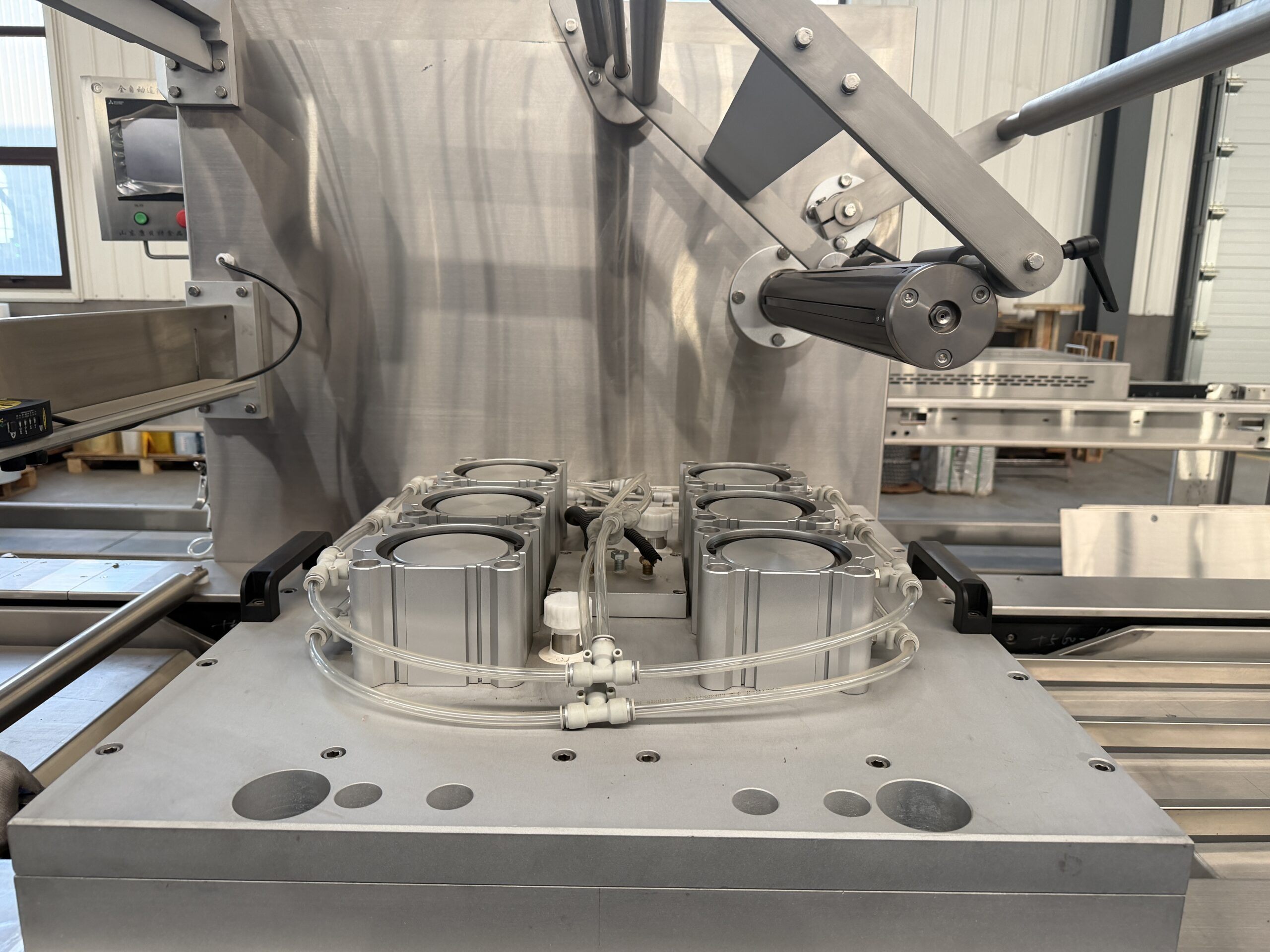
After 19 years of designing and building rotary MAP tray sealing machines and consulting with fresh meat processors across more than 100 countries, KBT Packaging’s technical team has fielded thousands of questions about the “right” MAP gas mixture. The honest answer is always: it depends on your meat type, your target shelf life, and your retail channel.
But “it depends” does not help a procurement manager or production engineer who needs a starting point today. This guide consolidates the science, industry data, and practical field experience into a working reference for fresh meat MAP gas mixture selection in 2026.
Understanding the Three Gases: What Each Component Does
Every MAP gas mixture for fresh meat is built from some combination of three gases. Understanding what each does is foundational to making the right mixture choice.
Oxygen (O₂) — The Color Stabilizer
Oxygen is present in MAP to preserve the appealing red color of fresh meat that consumers associate with freshness and quality. The science behind this is the formation of oxymyoglobin — the bright red pigment that forms when myoglobin in muscle tissue binds with oxygen. Deoxymyoglobin (the purple-red color of vacuum-packaged meat) converts to oxymyoglobin within 30-60 minutes of exposure to atmospheric oxygen levels.
For retail-ready fresh meat, oxygen levels below 50% result in rapid discoloration. The industry sweet spot of 60-80% O₂ maintains the bright cherry-red oxymyoglobin color throughout the typical 7-10 day retail display window.
However, oxygen also accelerates lipid oxidation in fatty tissues — a phenomenon called “warmed-over flavor” (WOF) in reheated cooked meat. For products intended for cooking rather than fresh retail display, reducing oxygen below 30% or eliminating it entirely is preferable.
Carbon Dioxide (CO₂) — The Bacteriostatic Agent
CO₂ is the workhorse of MAP antimicrobial protection. When CO₂ dissolves into the moisture film on the meat surface, it forms weak carbonic acid, which mildly acidifies the surface and inhibits the growth of aerobic spoilage organisms — particularly Pseudomonas spp., Brochothrix thermosphacta, and Enterobacteriaceae.
The bacteriostatic effect of CO₂ is concentration-dependent and time-limited: as CO₂ is progressively absorbed into the product over time, its inhibitory effect diminishes. This is why gas mixtures with high CO₂ levels are more effective when target shelf life is shorter (under 10 days).
Nitrogen (N₂) — The Inert Filler and Package Protector
Nitrogen plays three functional roles in MAP for fresh meat:
- Headspace maintenance: As CO₂ dissolves into the product over time, the package would collapse without an inert filler. N₂ maintains package volume and prevents the lidding film from pressing against the product surface.
- Pressure balancing: N₂ prevents excessive pressure differentials during temperature fluctuations in the cold chain — critical for export shipments.
- Fat oxidation buffer: By displacing oxygen, elevated N₂ levels slow oxidative rancidity in high-fat meat cuts.
Gas Mixture Reference Tables by Meat Type
Fresh Beef
| Application | Gas Mixture | Target Shelf Life | Color Quality | Best Retail Context |
|---|---|---|---|---|
| Standard retail (supermarket) | 70% O₂ / 20% CO₂ / 10% N₂ | 9-12 days (0-2°C) | Bright cherry-red | Volume retail, high throughput |
| HiOx-MAP (premium) | 80% O₂ / 20% CO₂ | 8-10 days | Very stable bright red | Premium butcher, farm shop, organic |
| Extended shelf life (export) | 50% O₂ / 30% CO₂ / 20% N₂ | 12-16 days | Good, slightly darker | Long-haul export, foodservice |
| Cooked/ready-to-eat beef | 30% CO₂ / 70% N₂ | 14-21 days | N/A (cooked color) | Deli, prepared meals, food service |
Fresh Pork
| Application | Gas Mixture | Target Shelf Life | Notes |
|---|---|---|---|
| Standard fresh pork cuts | 70% O₂ / 20% CO₂ / 10% N₂ | 7-10 days (0-4°C) | Similar to beef; pork fat oxidizes faster |
| High-fat cuts (belly, shoulder) | 50% O₂ / 30% CO₂ / 20% N₂ | 8-12 days | Reduced O₂ slows fat oxidation |
| Bacon (sliced) | 75% N₂ / 25% CO₂ | 21-28 days | Very low O₂ critical for fat stability |
Poultry (Chicken, Turkey, Duck)
| Application | Gas Mixture | Target Shelf Life | Notes |
|---|---|---|---|
| Fresh whole birds and parts | 60% CO₂ / 40% N₂ | 7-12 days (0-2°C) | O₂-free preferred; poultry color is not O₂-dependent |
| Marinated/injected poultry | 50% CO₂ / 30% N₂ / 20% O₂ | 8-10 days | O₂ helps maintain fresh appearance of marinades |
| Ready-to-cook portions | 40% CO₂ / 40% N₂ / 20% O₂ | 10-14 days | Moderate O₂ balances color and bacteriostasis |
Lamb and Mutton
| Application | Gas Mixture | Target Shelf Life | Notes |
|---|---|---|---|
| Fresh lamb cuts (retail) | 70% O₂ / 20% CO₂ / 10% N₂ | 8-11 days | Lamb fat is more susceptible to oxidation; consider N₂ elevation |
| Bone-in lamb cuts | 60% O₂ / 25% CO₂ / 15% N₂ | 7-9 days | Lower O₂ reduces purge risk at bone interface |
The Science: Why the Standard 70/20/10 Ratio Works for Beef
The ubiquitous 70% O₂ / 20% CO₂ / 10% N₂ mixture used worldwide for fresh red meat is not accidental — it reflects careful balancing of three competing requirements:
1. Color stability requires 60%+ O₂
Oxymyoglobin formation requires oxygen partial pressure above approximately 30-40 mmHg. At 70% O₂, the oxygen partial pressure far exceeds this threshold, ensuring rapid and stable color development within the first hour and maintenance throughout the retail window.
2. Bacteriostasis requires 15-25% CO₂
Research published in the International Journal of Food Microbiology demonstrates that CO₂ concentrations of 15-25% provide optimal bacteriostatic effect against the primary meat spoilage organisms without causing significant protein texture changes. At 60%+ CO₂, texture degradation becomes measurable after 10-12 days.
3. Package integrity requires N₂ as filler
A minimum of 10% N₂ maintains adequate headspace volume as CO₂ absorption progresses. Insufficient N₂ causes progressive vacuum formation inside the package, leading to lid collapse and increased purge.
HiOx-MAP: The Premium Retail Standard
High-oxygen MAP (HiOx-MAP) — typically 80% O₂ / 20% CO₂ — was pioneered by UK retailer Tesco in the early 2000s specifically to solve the color fade problem in standard 70/20/10 MAP beef over extended display periods.
HiOx-MAP delivers a measurably deeper red color (higher a* color coordinate in CIELAB measurements) and slower color degradation over time. However, it requires:
- High-barrier oxygen-scavenger films to prevent rapid O₂ ingress from atmosphere and fat oxidation — standard EVOH barrier films are insufficient
- Strict cold chain compliance — temperature excursions above 4°C dramatically accelerate both color fade and microbial growth under high-O₂ conditions
- Careful fat content assessment — high-fat cuts under HiOx-MAP can develop oxidative rancidity within 7 days
As of 2026, approximately 38% of UK retail fresh beef volume uses HiOx-MAP (AHDB/British Retail Consortium data). It is increasingly the standard for premium fresh beef in European and North American specialty retail.
From the KBT Engineering Lab: When we run MAP gas mixture trials with client product samples, we always test at least two ratios — the standard 70/20/10 and the client’s proposed alternative. In our experience, the color and microbial performance difference between 70% and 80% O₂ is substantial for premium cuts, but minimal for economy ground beef. Run the trial before committing to a film or gas supplier.
Low-Oxygen MAP: When You Need 14+ Days Shelf Life
For export markets, long-haul distribution, and foodservice supply chains requiring 14+ days of refrigerated shelf life, oxygen levels must drop to 30% or below.
Key characteristics:
- 30-50% O₂ / 30-40% CO₂ / 20-30% N₂ — extended shelf life up to 16-20 days
- Below 10% O₂ — color shifts to deoxymyoglobin (darker purple-red); not suitable for retail display but acceptable for foodservice cuts where color is not a purchase driver
- Below 5% O₂ — requires vacuum packaging or near-vacuum MAP with rotary tray sealers capable of achieving sub-1% residual oxygen. KBT’s rotary MAP machines routinely achieve 0.8-1.5% O₂ residual with gas flushing
CO₂ Dissolution Kinetics: Why Meat Type Matters
The rate at which CO₂ is absorbed into meat tissue — called dissolution kinetics — varies significantly by meat type and directly affects how much CO₂ you need in your initial gas mixture.
Key factors affecting CO₂ absorption:
- Fat content: Lean beef absorbs CO₂ faster than high-fat pork belly because CO₂ is more soluble in water than in fat. Lean cuts require higher initial CO₂ concentrations (25-30%) to maintain bacteriostatic levels throughout shelf life.
- Surface area to volume ratio: Thin-cut portions (steaks, slices) absorb CO₂ more rapidly than whole primal cuts. High-surface-area products benefit from higher initial CO₂ levels.
- Temperature: CO₂ dissolution increases at lower temperatures — a package at 0°C will absorb CO₂ faster than one at 8°C. Cold chain consistency matters for MAP shelf life.
- Moisture content and purge: Exudate (purge) on the meat surface absorbs CO₂ independently of the meat itself. Pre-packaging surface moisture reduces effective bacteriostatic CO₂ in the headspace.
Regulatory Standards for MAP Gases in 2026
European Union
Food-grade gases used in MAP are regulated under Regulation (EC) No 1333/2008 (food additives): CO₂ (E290), Nitrogen (E941), and Oxygen (E948) are all approved. MAP machinery must comply with EU Machinery Directive 2006/42/EC and EN 13418.
United States
The FDA classifies food-grade O₂, CO₂, and N₂ as GRAS (Generally Recognized As Safe) under 21 CFR Parts 172, 173, and 184. Meat and poultry MAP products must also comply with USDA FSIS Directive 7120.1.
Emerging 2026 Regulatory Developments
The EU’s revised Food Information to Consumers Regulation (FIR) will require MAP gas mixture disclosure on retail labels from 2027 — manufacturers should begin preparing gas mixture data sheets now. In the UK, BRCGS Global Standard for Packaging Materials Version 9 (effective January 2026) now includes specific requirements for MAP film barrier testing documentation.
Common MAP Gas Mixture Mistakes and How to Avoid Them
Mistake 1: Using Beef MAP Standards for Poultry
Oxygen-dependent color preservation (the rationale for high O₂ in beef MAP) does not apply to poultry, which consumers purchase based on skin color rather than myoglobin red color. Poultry-specific spoilage organisms also respond better to elevated CO₂ than to oxygen reduction. Using a 70/20/10 beef mixture on fresh chicken wastes oxygen where CO₂ would provide better microbiological performance.
Mistake 2: Ignoring Residual Oxygen Thresholds
A MAP gas mixture is only as good as its execution. If your tray sealing machine cannot achieve consistent residual oxygen below 2%, the actual atmosphere inside the package will not match your intended mixture. KBT’s gas flushing rotary tray sealers routinely achieve 0.8-1.5% residual O₂ — but operators must verify seal integrity on every cycle using leak detection testing (bubble tests or vacuum decay testing).
Mistake 3: Over-oxygenating High-Fat Cuts
Ground beef, pork belly, and marbled steaks are susceptible to lipid oxidation under high-O₂ conditions. Warmed-over flavor (WOF) can develop within 48 hours in high-fat products under 80% O₂ MAP. For ground meat, 50% O₂ / 30% CO₂ / 20% N₂ provides a better balance.
Mistake 4: Assuming All Films Are Equivalent
Your gas mixture and your packaging film are inseparable system components. A high-oxygen MAP mixture in a standard EVOH barrier film will perform very differently than the same mixture in an oxygen-scavenger film. Film oxygen transmission rate (OTR), CO₂TR, and WVTR all interact with your gas mixture to determine final package performance.
MAP Gas Mixture Selection Decision Framework
- Step 1 — Define your retail channel: Retail supermarket (bright color critical) = start with 70/20/10 or HiOx. Foodservice/export (shelf life critical) = start with 50/30/20 or lower O₂.
- Step 2 — Define your target shelf life: 7-10 days = 60-80% O₂ range. 10-16 days = reduce O₂ to 30-50%. 16+ days = sub-10% O₂ required.
- Step 3 — Assess fat content: High-fat cut or ground product = reduce O₂ by 10-20 percentage points vs. standard lean cut recommendation.
- Step 4 — Run a shelf life pilot: Test your product with two gas ratios before committing to production volumes. Request microbial testing (TVC) and sensory panel evaluation at day 0, 5, 10, and 15.
- Step 5 — Match your film to your mixture: High-O₂ mixtures (70%+) require high-barrier films with OTR below 3 cc/m²/day. Low-O₂ mixtures (under 20%) tolerate standard barrier films (OTR 5-15 cc/m²/day).
Conclusion: Start Here
If you are setting up a fresh meat MAP line and are uncertain where to begin, the following are reliable starting points:
- Fresh beef for retail: 70% O₂ / 20% CO₂ / 10% N₂
- Premium fresh beef: 80% O₂ / 20% CO₂
- Fresh pork cuts: 70% O₂ / 20% CO₂ / 10% N₂
- Fresh poultry: 60% CO₂ / 40% N₂
- Foodservice/export (extended shelf life): 50% O₂ / 30% CO₂ / 20% N₂
KBT Packaging’s rotary MAP tray sealing machines support all standard fresh meat gas mixtures and can be configured with single or multi-gas mixing systems. Our engineering team runs free product-sample MAP trials at our ISO 9001-certified facility in Shandong — bring your product and your target shelf life, and we will identify the optimal gas ratio and machine configuration for your operation.
Frequently Asked Questions
What is the best MAP gas mixture for fresh beef?
The industry-standard MAP gas mixture for fresh beef is 70% O₂ / 20% CO₂ / 10% N₂. This ratio preserves the bright red oxymyoglobin color consumers expect in retail environments while providing bacteriostatic protection from CO₂. Shelf life extension under this mixture is typically 9-12 days at 0-2°C refrigerated storage.
Can MAP extend shelf life of fresh pork and poultry the same way as beef?
Pork responds similarly to beef with a standard 70% O₂ / 20% CO₂ / 10% N₂ mixture. Poultry, however, benefits from an oxygen-free MAP mixture of 60% CO₂ / 40% N₂ because poultry does not require oxygen for color stability and CO₂-heavy mixtures are more effective against poultry-specific spoilage organisms including Pseudomonas spp. and Enterobacteriaceae.
What does CO2 partial pressure do in MAP for meat?
CO₂ is the active bacteriostatic agent in MAP. It dissolves in the meat surface moisture to form carbonic acid, which mildly acidifies the product surface and inhibits the growth of aerobic spoilage bacteria including Pseudomonas, Brochothrix thermosphacta, and lactic acid bacteria. The bacteriostatic effect is proportional to CO₂ concentration and decreases as CO₂ is absorbed into the product over time.
Why is nitrogen used in MAP gas mixtures?
Nitrogen (N₂) serves as an inert filler gas in MAP — it prevents package collapse as CO₂ is absorbed into the product and maintains headspace volume for handling. N₂ has no direct antimicrobial or color-preserving properties but plays a critical role in maintaining package integrity and preventing liquid purge during handling and distribution.
How does high-oxygen MAP differ from standard MAP for fresh meat?
High-oxygen MAP (HiOx-MAP) uses 80% O₂ / 20% CO₂ — deliberately elevating oxygen above the traditional 70% level — to achieve deeper oxygen penetration and more stable color over the full retail display window. HiOx-MAP was pioneered by retailers including Tesco and has gained significant adoption in premium European retail. It requires high-barrier oxygen-scavenger films to prevent rapid oxidation of fats.
What are the key regulatory standards for MAP meat packaging gas mixtures?
In the EU, MAP gas mixtures are regulated under Regulation (EC) No 1333/2008 on food additives — CO₂ (E290), nitrogen (E941), and oxygen (E948) are all approved. The US FDA classifies food-grade gases as GRAS. Gas flushing equipment must meet EU Machinery Directive 2006/42/EC and FDA 21 CFR Part 110. Residual oxygen levels in MAP must typically remain below 1-3% for optimal shelf life.