
Following our recent guide on MAP gas mixtures for seafood, many clients have asked the logical next question: how do we actually select the right MAP tray sealing machine for our production line? This is one of the most consequential equipment decisions a food processor makes — and unlike gas mixture selection, there is limited publicly available guidance on what to look for.
In this guide, our engineering team draws on 19 years of supplying MAP equipment to processors across 100+ countries to give you an honest, practical selection framework.
Why the Tray Sealer Machine Matters as Much as the Gas
A perfectly calibrated gas mixture will deliver nothing if your tray sealer cannot maintain consistent seal integrity, achieve reliable residual oxygen levels, or handle your specific tray and film combination. The machine is the foundation of your MAP operation — everything else is built on top of it.
Common consequences of choosing the wrong MAP tray sealer:
- Residual O₂ levels of 4-6% instead of the target <1.5% — dramatically reducing shelf life
- Inconsistent seal strength causing package failures during cold chain distribution
- Film wastage of 15-25% due to misaligned feeding systems
- Production bottlenecks that offset any gas savings from the MAP process
Step 1: Understand Your MAP Application Type
Before evaluating specific machines, clarify what type of MAP operation you are running:
Active MAP (Gas Flush / Gas Replace)
Air is actively removed from the tray and replaced with a calibrated gas mixture before sealing. The machine draws a partial vacuum (or uses displacement flushing) then backfills with the target gas blend. This is the most common approach for fresh meat, seafood, poultry, and ready meals.
Passive MAP (Barrier Modified Atmosphere)
The package is sealed with the ambient air inside — the gas composition is not actively controlled but is determined by the product’s respiration rate and the film’s permeability. This approach is common for fresh produce. Tray sealers for passive MAP do not require gas mixing equipment.
Skin Packaging (VSP)
A heated top film is drawn tightly over the product on a rigid tray or board using vacuum and heat. The result is a tight skin that conforms to the exact shape of the product. This is not technically MAP (the atmosphere is not modified) but is often grouped with MAP machines. VSP requires specialized top film and higher machine investment.
Most KBT clients running fresh protein lines are looking for Active MAP gas flushing machines. Make sure you know which category your application falls into before evaluating equipment.
Step 2: Key Machine Specifications to Evaluate
Vacuum & Gas Flushing Performance
These are the most critical specifications — and the ones most likely to be overstated in marketing materials. Look for:
- Ultimate vacuum level: Should reach <50 mbar for reliable gas flushing. Machines with ultimate vacuum above 100 mbar will struggle to achieve low residual O₂ levels.
- Gas flushing residual O₂: The spec you care about. Top machines deliver <1.5% residual O₂ with proper gas mixtures. Verify this with test documentation, not just a marketing claim.
- Gas consumption per cycle: Higher efficiency machines use less gas per pack — a significant ongoing cost factor. Request the actual gas consumption rate from the manufacturer.
- Gas mixing system: Does the machine have an integrated gas mixer, or do you need to source one separately? Integrated systems are more reliable but more expensive to service.
Sealing System
The seal is your product’s primary barrier against contamination and gas leakage. Evaluate:
- Seal type: Thermal impulse (most common for MAP), hot bar (lower cost, more consistent for simple films), ultrasonic (best for difficult films but higher cost)
- Seal width: Minimum 8mm for food safety; 12mm+ for heavy-duty or bone-in applications
- Temperature accuracy: Within ±5°C of setpoint for consistent seal quality across production runs
- Seal wire material: PTFE-coated镍铬合金 (NiCr) wires resist carbon buildup and have longer service life
Cycle Speed and Throughput
Match the machine speed to your production volume:
| Machine Type | Cycle Speed | Best For |
|---|---|---|
| Manual/Semi-automatic tray sealer | 3-6 cycles/min | Small batch processors, R&D, startups |
| Automatic inline tray sealer | 6-10 cycles/min | Mid-volume food processors, regional retail suppliers |
| Rotary MAP tray sealer | 10-18 cycles/min | High-volume processors, major retail and export suppliers |
| Thermoforming MAP machine | 8-15 cycles/min (per lane) | Highest volume, where film cost savings justify investment |
When calculating your required throughput, build in a 20-30% buffer above your current volume to account for demand growth, seasonal peaks, and machine maintenance downtime.
Tray and Film Compatibility
Not all tray sealers handle all tray formats. Check these specifications before purchase:
- Maximum tray depth: Some machines are limited to 40mm depth; deep-chamber machines handle 80-120mm for bone-in products and bulk packs.
- Maximum tray area: Measure your largest tray format and verify compatibility. Standard is 400x300mm; large-format machines handle up to 600x500mm.
- Film format: Roll-fed vs. pre-cut lid. Roll-fed is more cost-effective for high volume; pre-cut lid gives more flexibility for small batches.
- Film thickness range: Confirm your specific film gauge is supported. Most machines handle 20-100 micron.
Step 3: Evaluate the Control System
The machine’s control system is where quality consistency lives. Look for:
- PLC control: At minimum, a Siemens or Mitsubishi PLC-based control system for reliable operation and service support. Avoid machines with proprietary or undocumented control systems.
- HMI interface: Color touch screen HMI with intuitive recipe management for different products. Operators should be able to switch between product configurations in under 60 seconds.
- Gas flushing parameter control: The ability to independently set vacuum level, flush pressure, flush time, and gas composition for each recipe.
- Data logging: At minimum, log date/time, operator ID, product recipe, cycle count, and any alarm events. For regulated markets (meat, dairy), the ability to export data for audit compliance is essential.
- Remote diagnostics: Ethernet or WiFi connectivity for remote troubleshooting — significantly reduces service response time when issues arise.
Step 4: Calculate Your 3-Year Total Cost of Ownership
The purchase price is typically 40-60% of your 3-year total cost of ownership for a MAP tray sealer. Factor in:
Capital & Installation
- Machine purchase price (typically USD 12,000-45,000 for automatic; USD 45,000-150,000 for rotary/thermoforming)
- Freight, customs clearance, installation (budget 8-15% of machine cost)
- Gas mixing system if not included (USD 3,000-12,000)
- Film tray molds if needed (USD 1,500-5,000 per tray format)
Ongoing Operating Costs (per year)
- MAP gas consumption (varies widely: USD 0.02-0.08 per pack depending on pack size and machine efficiency)
- Seal wires and wearing parts (budget USD 800-2,500/year)
- Preventive maintenance contracts (USD 1,500-4,000/year for professional service)
- Electrical consumption (compare: manual press: 2-3 kW/h; rotary: 8-15 kW/h)
Hidden Cost Factors
- Film wastage: Poorly configured machines can waste 10-20% of film in setup and misfeeds
- Product loss: Seal failures cause product wastage — the cost per failed pack is typically 3-5x the material cost
- Downtime cost: Each hour of unplanned downtime costs your production throughput and may trigger costly customer penalties
Step 5: Verify Service and Spare Parts Support
This step is often skipped in the enthusiasm of a good price, but it is critical. Ask potential suppliers:
- What is the typical lead time for spare parts? (Critical parts should be available within 48-72 hours)
- Do you have a local service engineer or authorized technician in my region?
- Can I access remote diagnostics support for troubleshooting?
- What training is included with the purchase?
- Do you provide free sample testing with my actual product before I commit to purchase?
KBT Packing provides free product-sample testing at our Shandong facility before purchase — we run your actual product on our machines with your tray and film specifications to verify real-world performance before you commit. This is the single most important pre-purchase step you can take.
Common Mistakes in MAP Tray Sealer Selection
Mistake 1: Buying on Price Alone
A machine that costs 20% less but produces 15% more film waste and achieves 4% residual O₂ instead of 1.5% will cost you more over 36 months than a machine priced higher upfront with better efficiency.
Mistake 2: Ignoring the Gas Mixing System
The gas mixing system is often sold separately or as an add-on. Ensure your total budget includes a properly specified gas mixer from day one — adding it later often creates compatibility issues and voids warranty.
Mistake 3: Not Running Your Actual Product
Paper specs cannot tell you how a machine handles your specific tray depth, film gauge, or product shape. Always request a product trial with real materials before purchase. Be skeptical of suppliers who cannot accommodate this.
Mistake 4: Under-specifying Film Barrier Requirements
Even the best machine cannot compensate for the wrong film. If you need high-barrier performance (e.g., for export to hot climates), specify multi-layer EVOH barrier films — and verify your machine’s compatible film range includes this specification.
Why Processors Choose KBT Packing for MAP Equipment
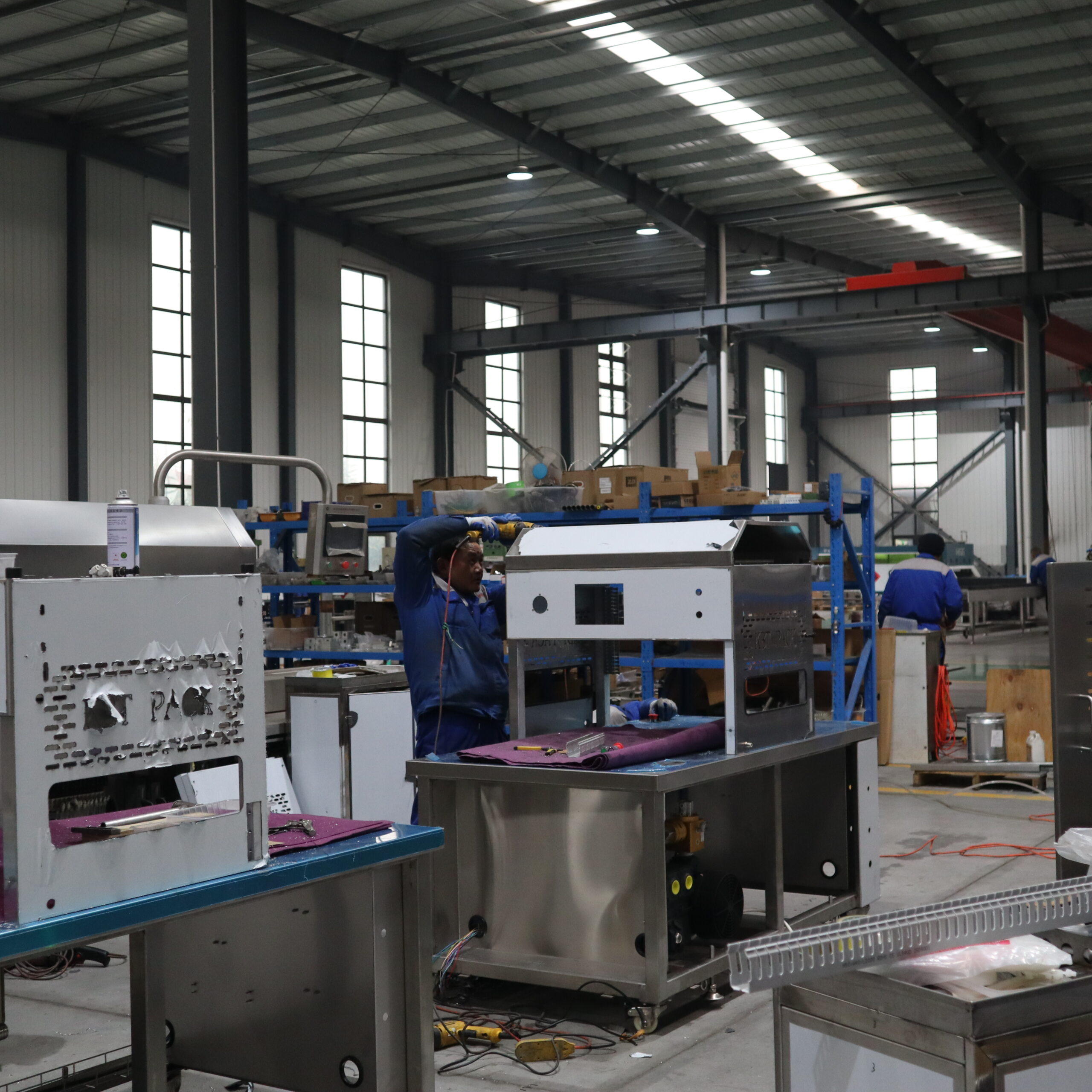
Since 2006, KBT Packing has designed and manufactured MAP tray sealing machines at our ISO 9001-certified facility in Shandong, China. Our MAP machine line covers all scales from semi-automatic start-up equipment through high-speed rotary machines for major food processors.
What our clients tell us they value most:
- Proven performance data: We publish our real gas flushing residual O₂ specifications — verified with documented test results, not marketing claims.
- Pre-purchase product testing: Send us your tray, film, and product sample. We run the test and provide you the actual results before you decide.
- Global service network: With service partners in 28 countries and remote diagnostic support, we respond to equipment issues quickly, minimizing your production downtime.
- Full MAP line capability: Beyond tray sealers, we supply gas mixing systems, thermoforming machines, and VSP equipment as a complete MAP line solution.
Contact our engineering team to discuss your MAP application and schedule a product sample test at our facility.
Frequently Asked Questions
What is the difference between MAP tray sealer and vacuum chamber packer?
A MAP tray sealer seals pre-formed trays with a gas-flushed environment inside the tray before lidding. A vacuum chamber packer draws a full vacuum on the entire package inside a sealed chamber before closing. MAP tray sealers preserve product appearance better; chamber packers achieve deeper vacuum and are better for bulk storage and bones.
What oxygen residual level should a MAP tray sealer achieve?
Top-tier MAP tray sealers achieve residual O₂ below 1.5% with properly calibrated gas flushing. Lower-cost machines often deliver 3-5% residual O₂, which significantly reduces effective shelf life. Always verify the flush performance specification with the manufacturer before purchase.
What film types are compatible with MAP tray sealers?
MAP tray sealers work with rigid plastic trays (APET, CPET, PP, EPS) and flexible lidding films (PA/PE, PET/PE, laminated barrier films). For high-barrier applications, multi-layer coextruded films with EVOH barrier layers are required. Ensure your machine’s max film thickness and tray depth specifications match your product requirements.
How do I calculate ROI for a MAP tray sealer investment?
Key inputs: machine cost, expected pack output per shift, cost of MAP gas per pack, and the value of shelf-life extension vs. conventional packaging. A typical ROI threshold for MAP equipment is 18-24 months if processing high-value proteins. For commodity products with lower margin, payback extends to 30-36 months.
What maintenance is required for MAP tray sealers?
Essential maintenance includes: daily seal wire cleaning (carbon buildup degrades seal quality), weekly gas flow meter calibration check, monthly vacuum pump oil change, quarterly film path alignment inspection, and annual professional calibration of the gas mixing system. Operators should log all maintenance activities for quality audit compliance.
What production speed should I target for MAP tray sealing?
Entry-level semi-automatic tray sealers: 3-6 cycles/min. Mid-range automatic: 6-10 cycles/min. High-speed rotary machines: 10-18 cycles/min. For operations running more than 60 packs/min, multiple lanes or a high-speed rotary system becomes cost-effective. Match your target speed to your actual production volume and consider 20-30% excess capacity as a buffer for demand growth.